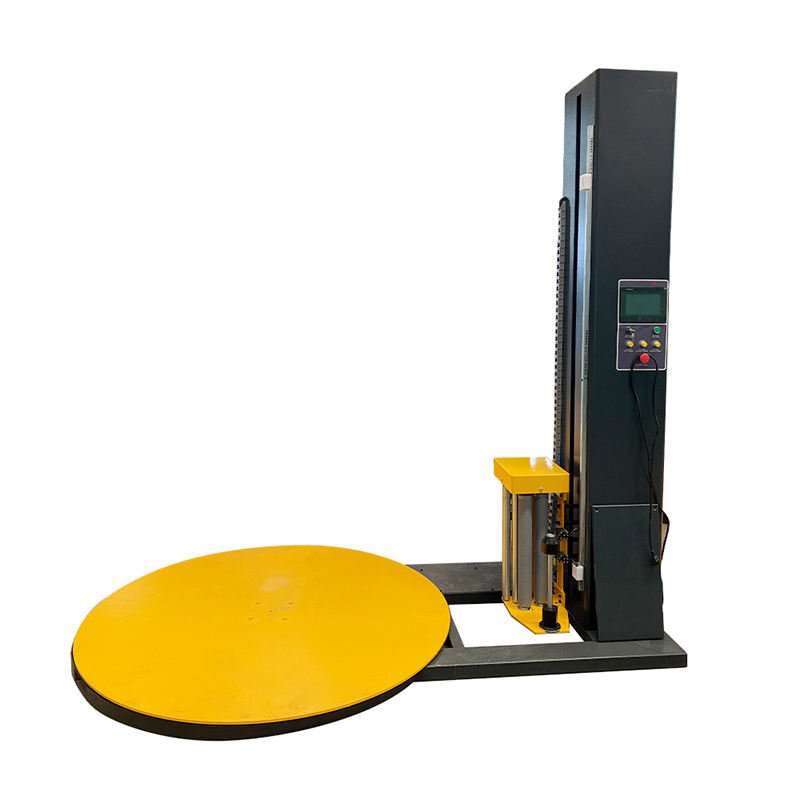
In modern manufacturing, warehousing, and logistics, securing palletized goods is essential for safe transportation and efficient storage. A pallet wrapping machine helps businesses stabilize products on pallets by applying stretch film around the load, reducing the risk of shifting, falling, and damage during handling and transportation.
Whether you operate a manufacturing facility, distribution center, or logistics warehouse, choosing the right pallet stretch wrapping machine can improve packaging efficiency, reduce labor costs, and ensure consistent load protection.
In this guide, we will explain how pallet wrapping machines work, introduce the main types, discuss their benefits, and share practical tips for choosing the right machine for your business.
1. What Is a Pallet Wrapping Machine?
A pallet wrapping machine is an industrial packaging machine designed to wrap stretch film around goods stacked on a pallet. The film creates a secure holding force that keeps products together and helps protect them from dust, moisture, and movement during transportation.
Unlike manual wrapping, which requires workers to walk around the pallet and apply stretch film by hand, a machine provides more consistent wrapping results with less physical effort.
Pallet stretch wrapping machines are widely used in:
- Manufacturing plants
- Warehouses and distribution centers
- Food and beverage industries
- Chemical and pharmaceutical industries
- Logistics and transportation companies
- Building materials and paper industries
Depending on production requirements, businesses can choose from semi-automatic, automatic, and mobile pallet wrapping machines.
2. How Does a Pallet Wrapping Machine Work?
Although different machines have different structures, most pallet stretch wrappers use a similar wrapping process.
Step 1: Load Positioning
The palletized goods are placed in the wrapping area. Depending on the machine type, the pallet may be positioned on a turntable, inside an automatic wrapping station, or approached by a mobile wrapping machine.
Step 2: Stretch Film Attachment
The stretch film is attached to the pallet or the bottom of the load. The film carriage holds the roll and controls film delivery during wrapping.
Step 3: Wrapping the Pallet
The machine applies stretch film around the load. A turntable rotates the pallet, or a mobile machine moves around the stationary load.
The wrapping program can control the number of wrapping cycles, film tension, and reinforcement at the top and bottom of the pallet.
Step 4: Film Cutting and Finishing
After the wrapping cycle is completed, the film is cut and secured. Depending on the machine configuration, this process may be manual or automatic.
The wrapped pallet is then ready for storage, handling, or transportation.
3. Main Types of Pallet Wrapping Machines
Different pallet wrapping machines are designed for different production environments, pallet sizes, and packaging requirements.
3.1 Semi-Automatic Turntable Pallet Wrapping Machine
A semi-automatic turntable pallet wrapping machine is a common solution for small and medium-sized businesses.
The operator places the pallet on a rotating platform, attaches the stretch film, and starts the wrapping cycle. The machine automatically wraps the load according to the selected program.
Main advantages:
- Simple operation
- Relatively low investment cost
- Consistent wrapping quality
- Suitable for low to medium packaging volumes
This type is suitable for warehouses and factories that need reliable pallet packaging without a fully automated production line.
3.2 Automatic Pallet Wrapping Machine
An automatic pallet wrapping machine is designed for higher-volume packaging operations.
It can be integrated into conveyor systems and production lines. Depending on its configuration, the machine can automatically detect pallets, apply stretch film, complete wrapping cycles, and release finished loads.
Main advantages:
- Reduced manual labor
- Higher packaging efficiency
- Consistent wrapping performance
- Suitable for continuous production
Automatic pallet wrapping machines are ideal for factories and distribution centers with frequent pallet packaging requirements.
3.3 Mobile Pallet Wrapping Machine
A mobile pallet wrapping machine, also known as a self-propelled pallet wrapper, moves around a stationary pallet to apply stretch film.
Unlike turntable machines, it does not require the pallet to rotate. This makes it useful for wrapping oversized, heavy, or unstable loads that are difficult to move.
Main advantages:
- Flexible operation
- No need to rotate heavy pallets
- Suitable for different pallet sizes
- Convenient for large warehouses
Mobile pallet wrappers are particularly useful when pallets are stored in fixed locations or when moving loads onto a turntable is inconven